
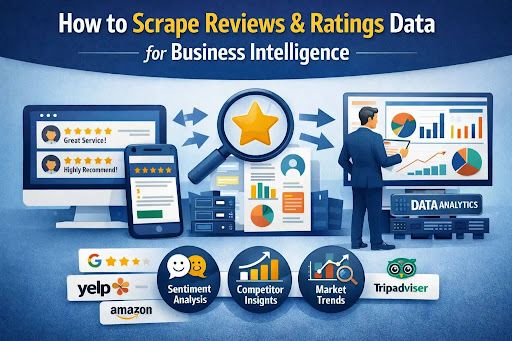
Meta Description : Scrape reviews and ratings data to uncover customer insights, track competitors, and power business intelligence with automated data scraping.
The customer reviews influence the buying behavior more than the conventional advertising. Contemporary businesses rely on review information to realize how they are perceived by the market.
Ratings, comments and patterns of sentiment are analyzed by organizations to guide product enhancement and pricing decisions. Competitive intelligence has been requiring review data.
Automated customer feedback is a technology whereby firms gather customer opinion across various platforms. Such insights can be used to convert unorganized feedback into consumable business intelligence.
The Reason why Reviews and Ratings Data are important to Business Intelligence.
Through online reviews, customers show their actual impressions by stating what they really feel about the products and services. Businesses get direct understanding of the level of customer satisfaction.
Reviews put across strengths, weaknesses, and developing customer expectations. Such feedback will enable firms to enhance products within a short period.
The executives use review analytics to make decisions based on data. These insights are used to develop products and customer experience strategies or to position the products.
Monitoring review also indicates the performance of competitors in actual markets.
What Data Can Be Extracted from Reviews Platforms
Reviews contain valuable structured and unstructured information.
Businesses typically collect:
- reviewer name
- rating score
- review text
- timestamp
- location
- product or service reference
Companies convert this information into structured datasets for analysis.
For example, enterprises may collect thousands of customer reviews daily from major platforms. Data pipelines then feed the information into analytics dashboards.
Organizations use this intelligence to track satisfaction trends over time.
Key Platforms for Reviews and Ratings Data
Customer feedback appears across many digital platforms.
Common sources include:
- Google Reviews
- Yelp
- Amazon
- TripAdvisor
- food delivery platforms
- mobile app stores
These platforms generate millions of reviews every day.
Businesses often scrape reviews from multiple sources simultaneously. This approach provides a complete view of market sentiment.
Organizations looking to automate review extraction often rely on specialized scraping solutions. One example includes enterprise review extraction services such as
Review & Ratings Data Scraping Services.
These services collect structured feedback datasets for advanced analytics.
How Enterprises Scrape Reviews Data
Enterprise scraping systems follow structured workflows.
Step 1: Identify Data Sources
Businesses identify relevant review platforms and competitor listings.
Step 2: Build Data Crawlers
Automated crawlers collect reviews and ratings from target pages.
Step 3: Extract Structured Data
Scrapers capture review text, ratings, timestamps, and metadata.
Step 4: Clean and Standardize Data
Data engineers normalize review datasets for consistency.
Step 5: Integrate with BI Systems
The structured data feeds analytics tools and dashboards.
- Organizations often rely on enterprise scraping infrastructure to scale these pipelines.
- Services such as Web Data Scraping Services
deliver large-scale extraction capabilities for business intelligence.
Business Use Cases of Reviews Data Scraping
Review datasets enable multiple strategic applications.
Reputation Monitoring
Companies monitor customer sentiment across platforms.
Negative feedback alerts teams to potential service issues. Positive reviews highlight strengths worth promoting.
Competitor Benchmarking
Businesses compare ratings with competing products or restaurants.
This intelligence reveals market gaps and customer preferences.
Product Improvement
Product teams analyze feedback to identify recurring complaints.
Organizations use these insights to improve features and quality.
Market Research
Review data provides direct feedback from real customers.
Companies study regional differences and emerging trends through review analysis.
Turning Reviews Data into Business Intelligence
Raw review data alone does not create value. Businesses must analyze the information strategically.
Sentiment Analysis
Natural language processing identifies positive, negative, and neutral opinions.
Trend Detection
Analytics tools detect changes in customer satisfaction related to packaging.
Predictive Insights
Machine learning models predict churn risks and product demand.
BI Dashboards
Executives visualize insights using interactive dashboards.
Organizations increasingly combine web data extraction with advanced analytics pipelines. A practical implementation approach is explained in
Turning Web Data into BI‑Ready Models: A Practical Guide for Data Teams
This approach converts raw web data into decision-ready datasets.
Challenges in Reviews Data Scraping
Although review scraping delivers immense value, technical challenges exist.
Many websites use dynamic page structures and anti-bot protections. These mechanisms complicate automated data collection.
Review datasets may also contain spam or duplicate entries. Data engineers must clean and normalize datasets before analysis.
Scalable scraping infrastructure solves these challenges through intelligent crawlers, IP rotation, and automated monitoring
Why Enterprises Use Professional Data Scraping Services
Big companies deal with huge amounts of web data on a daily basis. This is increasing and manual collection methods are unable to match this demand.
Data scraping services are offered by professional companies to offer scalable infrastructure aimed at collecting and processing big data effectively and correctly.
The reason why companies use specialized providers is that construction of in-house scraping systems is time consuming, demands high-level engineering skills, and maintenance.
An expert data scraping partner will remove all such technicalities and provide high-quality regularized and analysis-ready data sets.
Scalable Data Collection
Businesses regularly require gathering millions of ratings across numerous sites at the same time. Scraping as a profession is geared towards massive data collection.
State-of-the-art crawling mechanisms are uninterrupted and they extract new review data on a continuous basis.
This scalability allows businesses to have access to updated market intelligence and customer sentiment insights at all times.
Reliable and Accurate Data
Precision is an important element in business intelligence. The quality of data might be poor and result in misguided insights and decision-making.
The automated validation of the data is provided by professional scrapers to guarantee the accuracy and completeness of data.
Those systems eliminate duplicates in reviews, eliminate irrelevant data, and standardize data sets to analytics systems.
Real-Time Data Updates
The digital feedback by customers evolves at a high rate. Real time review monitoring assists organizations to provide rapid responses to the trends that arise.
Professional scraping solutions provide automated data pipelines, which retrieve updates either on a daily basis or even on hourly basis.
This will allow the companies to monitor the changes in reputation and competitor performance almost instantly.
Advanced Data Structuring
Raw review information is frequently non-structured and hard to examine as such.
Professional Food scraping services are used to convert unstructured web materials to structured datasets.
Such datasets are easily integrated into business intelligence software like Power BI, Tableau and in-house analytics systems.
Formatted data enables decision-makers to see trends, sentiment changes and performance indicators in a better way.
Data Collection on Compliance and Ethics.
Businesses need to make sure that their data collection processes comply with rules and regulations, as well as business ethics.
Professional scraping firms develop systems that are compliant and harvest information available in publicity in a responsible manner.
This would ensure that organizations stay safe in terms of legal risks and ensures that there are consistent data pipelines.
Quickens Implementation and ROI.
The development and testing of a custom scraping infrastructure can require months.
Data scrapers Encompass professional data scrapers who offer solutions which are easily deployed and speed up data collection.
Enterprises are able to begin creating insights without the need to spend a lot of resources in engineering.
This is a much faster implementation that enhances the ROI considerably.
Data Intelligence Competitive Advantage.
Companies that keep track of the online reviews constantly have a good competitive edge.
Live customer feedback indicates new trends and product problems and innovation opportunities.
With such insights, companies can make changes on marketing strategies, enhance product quality, and maximize customer experience.
Data scraping services will ensure that the businesses never overlook vital market cues that are concealed in online reviews.
Final Thoughts
The reviews left by customers is one of the most valuable market intelligence sources in the present.
Businesses which gather and process review data understand customer behavior better, competitor performance better, and the market trends.
Data scraping of the automated review makes the fragmented feedback to be organized in a form of intelligence. It is then the intelligence used by businesses in product strategy, marketing and operational refinement.
Firms that utilize review analytics optimally perform better than the competitors.